Employee transport services decide whether a 7 am shift starts on time and whether a colleague finishing at 1 am gets home without worry. For an IT park in Whitefield, a contact centre in Noida, a hospital in Hyderabad or a component plant outside Pune, the commute is part of the job. RutzIndia.com plans and runs staff transport on fixed rosters: cabs for small clusters, Tempo Travellers and Urbanias for mid-sized routes, and mini buses or coaches for large shifts, billed to the company once a month with a trip sheet for every run.
Employee transport services: cost per seat and per route
Employee transport services are priced per vehicle per shift leg. A Tempo Traveller doing one pickup and one drop costs Rs 23,400 a day, about Rs 1,470 per seat for 16 seats; a mini bus costs Rs 50,400 a day, about Rs 1,440 per seat for 35. A cab leg starts at Rs 4,320 Pay Now to Reserve. Prices exclude 5% GST, tolls and parking.
Each shift leg is billed on our 4 hr / 40 km package for the vehicle class, which covers a typical morning pickup route or an evening drop route inside a metro. A day with both a pickup and a drop is two legs. Routes that run longer than 40 km or four hours are billed for the extra at the class rates. The table uses Delhi, Hyderabad, Pune and Chennai base rates; Mumbai is 10% higher and Bangalore 5% higher on these packages.
| Vehicle | Seats | One shift leg (4 hr / 40 km) | Pickup + drop per day | 22 working days | Per seat per day (full) |
|---|---|---|---|---|---|
| Compact sedan (Dzire) | 4 | Rs 4,320 Pay Now to Reserve | Rs 8,640 Pay Now to Reserve | Rs 1,90,080 Pay Now to Reserve | Rs 2,160 Pay Now to Reserve |
| MUV (Ertiga, Carens) | 6 | Rs 5,400 Pay Now to Reserve | Rs 10,800 Pay Now to Reserve | Rs 2,37,600 Pay Now to Reserve | Rs 1,800 Pay Now to Reserve |
| Innova Crysta | 6 | Rs 7,560 Pay Now to Reserve | Rs 15,120 Pay Now to Reserve | Rs 3,32,640 Pay Now to Reserve | Rs 2,520 Pay Now to Reserve |
| Tempo Traveller | 16 | Rs 11,700 Pay Now to Reserve | Rs 23,400 Pay Now to Reserve | Rs 5,14,800 Pay Now to Reserve | about Rs 1,470 Pay Now to Reserve |
| Force Urbania | 17 | Rs 16,200 Pay Now to Reserve | Rs 32,400 Pay Now to Reserve | Rs 7,12,800 Pay Now to Reserve | about Rs 1,910 Pay Now to Reserve |
| Mini bus | 35 | Rs 25,200 Pay Now to Reserve | Rs 50,400 Pay Now to Reserve | Rs 11,08,800 Pay Now to Reserve | Rs 1,440 Pay Now to Reserve |
| Luxury coach (Volvo / Scania) | 45 | Rs 43,200 Pay Now to Reserve | Rs 86,400 Pay Now to Reserve | Rs 19,00,800 Pay Now to Reserve | Rs 1,920 Pay Now to Reserve |
All rates are before 5% GST. Tolls, parking and any interstate entry tax (common on Delhi to Gurgaon or Noida routes) are billed at actual cost. Long-term contracts are quoted in writing after a route study, and the quote will not exceed the package arithmetic above.

How a shift transport programme is planned
The difference between a transport programme that runs smoothly and one that generates complaints every morning is almost always in the planning. Before the first vehicle rolls, we work through the same sequence with your admin or facilities team.
- Collect the data. You share an anonymised list of employees by shift, home locality or pin code, and any special needs. We do not need names at this stage.
- Cluster and route. Addresses are grouped into clusters and each cluster is matched to a vehicle size. A dense cluster of 14 people in Indirapuram suits a Tempo Traveller; three people in scattered sectors suit a cab.
- Set pickup windows. Each stop gets a pickup time, working backwards from the shift start with a buffer for known traffic points, such as the Mahipalpur flyover, Silk Board junction or the Hinjewadi bridge.
- Pilot for a week. We run the routes with a transport supervisor riding along, then adjust stop order and timings from what actually happened.
- Freeze the roster. Routes are published to employees with the vehicle number and driver contact, and changes go through your transport desk.
Rosters change as people join, leave or move house. A good programme reviews routes monthly and absorbs new joiners within a few days rather than waiting for the next quarter.
Night-drop practices for women employees
Many companies in India include employee commute in their internal policy on safety and the prevention of sexual harassment at the workplace, especially for women working late shifts. RutzIndia.com is a transport provider, not a legal adviser, and we do not certify any client's compliance. What we do is run night drops in line with the practices your policy sets, and in the absence of a written client policy we follow a default set of practices:
- Routing order. Where the route allows, a woman employee is not the first person picked up or the last person dropped during night hours. When that cannot be avoided, the transport desk is told in advance so your team can decide on an escort or an alternative arrangement.
- Door-to-door drops. The vehicle stops at the employee's gate or building entrance, not at the main road, and the driver waits until she confirms she is inside.
- Trip confirmations. The driver or supervisor sends start and drop-complete confirmations to your transport desk for each night trip, so every drop is accounted for on the night, not the next morning.
- Verified addresses. Home addresses for night drops are confirmed with the employee before the first drop, and any change of address goes through your desk, not a phone call to the driver.
- No unscheduled stops or passengers. Drivers do not stop for fuel, food or other passengers once a night route has started, and only rostered employees board.
- Driver screening. Drivers on staff routes have their licence and commercial badge checked and go through background verification before they are assigned, and they are briefed on conduct expectations for shift work.
- A reachable escalation line. Employees on night routes have the desk's WhatsApp contact and your internal helpline number printed on the roster.
These practices are a baseline. If your policy asks for more, such as a security escort on specific routes or a two-person rule for drops after a certain hour, we build it into the route plan and the price.

Choosing vehicles for staff routes
Matching vehicle size to cluster density keeps both the cost per seat and the time on board down.
Cabs for scattered or senior staff
Sedans and MUVs suit small clusters, late-night singles and senior staff who travel alone. An Ertiga at Rs 5,400 Pay Now to Reserve a leg carries up to six people and is often cheaper per seat than two sedans. For leadership commutes, a dedicated monthly car rental with driver works better than a shared route.
Tempo Travellers and Urbanias for mid-sized routes
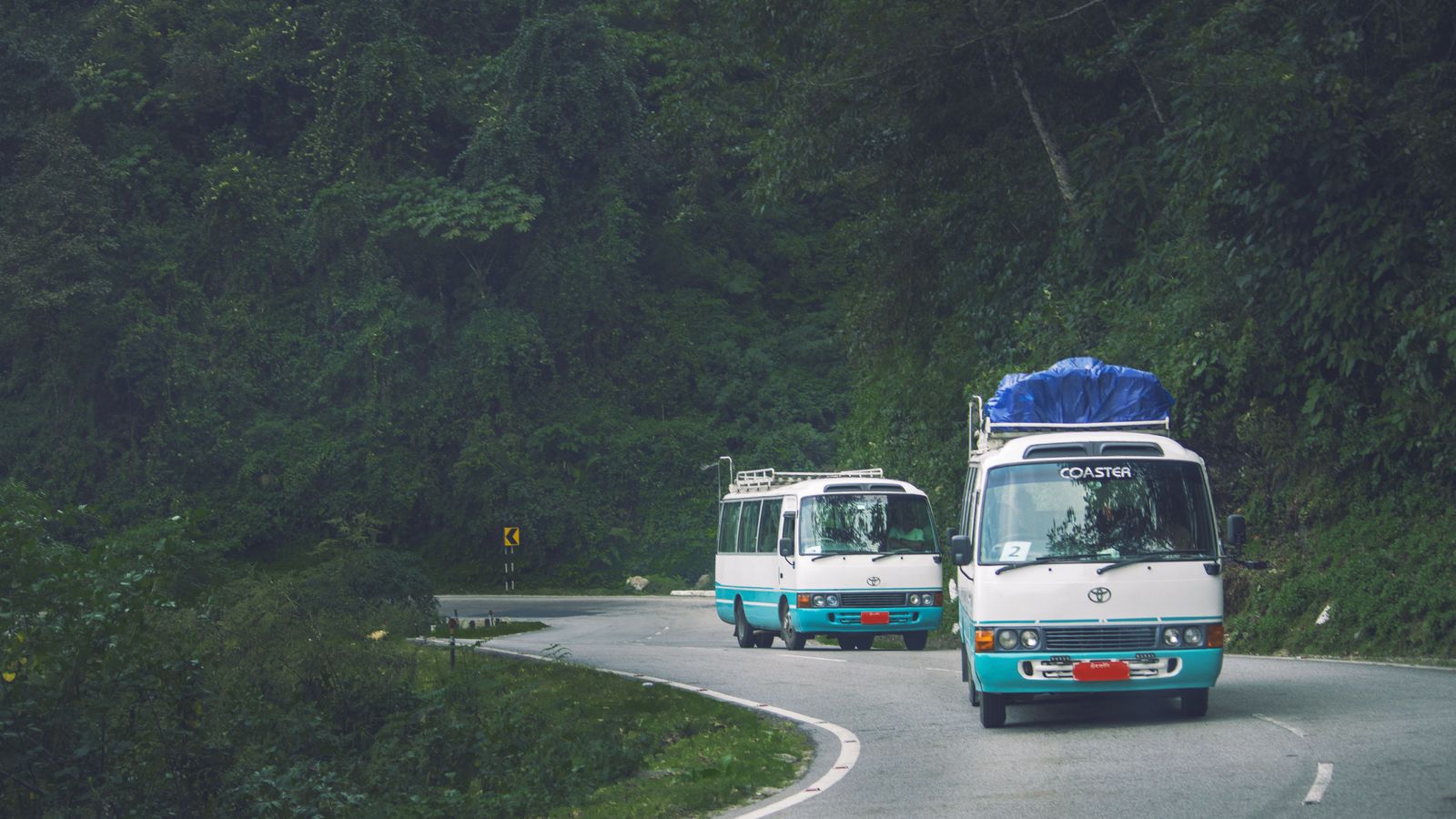
A 12 to 20 seat Tempo Traveller is the workhorse of Indian staff transport: narrow enough for colony lanes, large enough to bring the per-seat cost under Rs 1,500 a day. The Force Urbania costs more but has a flatter floor, bigger windows and better ride quality, which staff notice on 50-minute commutes. A 12-seater Tempo Traveller fits routes where lanes are too tight for the longer versions.
Mini buses and coaches for large shifts
For a plant shift of 30 to 45 people from one township, a mini bus or a Volvo coach brings the per-seat cost to its lowest and puts fewer vehicles on congested roads. Coaches suit campus-to-metro-station feeder loops too.
All vehicles are within four model years of age and carry valid commercial registration, fitness and permit papers. Registration status of any vehicle can be checked on the government Parivahan portal, and national road-safety guidance for commercial fleets is published by the Ministry of Road Transport and Highways.
Reporting, trip sheets and billing
Your transport desk needs to know, every day, that each route ran and when. For each run we record the reporting time at the first stop, the actual boarding and drop times where the route supervisor captures them, odometer readings and any exceptions such as a no-show employee or a road closure. A daily exception summary goes to the transport desk, and all trip sheets are bundled with the monthly invoice.
Billing is consolidated: one GST invoice per month per billing entity, with our GSTIN and yours and the correct place of supply, broken down by route, vehicle, shift and cost centre if you need it. Supplier GST details can be verified on the official GST portal. Ad-hoc trips outside the roster, such as a late project night or an airport run for a new joiner, go on the same invoice under our corporate car rental account. Multi-day outstation duties, such as a team visit to a second plant, follow the outstation rules: at least 250 km per calendar day on round trips and a driver night allowance of Rs 1,500 per night.
What happens on disruption days
Monsoon waterlogging in Mumbai and Gurgaon, a sudden bandh, Diwali and Holi traffic, and late-night detours during festival processions all affect staff routes. On these days the desk sends revised pickup times to your transport team the evening before where possible, switches vehicles on flood-prone routes, and records the exceptions on the trip sheet so there is no dispute at month end.

Cities and industrial corridors we serve
We run staff transport in the main office and industrial clusters, including Gurgaon's Cyber City and Udyog Vihar, Noida's sector corridor along the expressway, Bangalore's Whitefield, Outer Ring Road and Electronic City, Hyderabad's HITEC City and Gachibowli, Pune's Hinjewadi and Kharadi, Chennai's OMR and the Sriperumbudur belt, and Kolkata's Salt Lake Sector V. City pages such as taxi service in Gurgaon, taxi service in Noida, taxi service in Bangalore and taxi service in Hyderabad cover local conditions and airport links for new joiners and visitors.
Per-km and per-seat economics by vehicle
Shift legs inside the city are billed as 4 hr / 40 km packages, but routes to plants and campuses outside the city limits, and ad-hoc offsite trips, are billed per kilometre. Dividing the per-km rate by the seats shows why larger vehicles win on dense routes.
| Vehicle | Seats | Per km | Per seat-km at full load | Shift leg (4 hr / 40 km) | Offsite round trip, 250 km/day minimum |
|---|---|---|---|---|---|
| Dzire | 4 | Rs 36 | Rs 9 | Rs 4,320 Pay Now to Reserve | Rs 9,000 Pay Now to Reserve |
| Ertiga / Carens | 6 | Rs 42 | Rs 7 | Rs 5,400 Pay Now to Reserve | Rs 10,500 Pay Now to Reserve |
| Innova Crysta | 6 | Rs 57.6 | Rs 9.5 | Rs 7,560 Pay Now to Reserve | Rs 14,250 Pay Now to Reserve |
| Tempo Traveller | 16 | Rs 78 | Rs 4.9 | Rs 11,700 Pay Now to Reserve | Rs 19,500 Pay Now to Reserve |
| Force Urbania | 17 | Rs 102 | Rs 6 | Rs 16,200 Pay Now to Reserve | Rs 25,500 Pay Now to Reserve |
| Mini bus | 35 | Rs 130 | Rs 3.8 | Rs 25,200 Pay Now to Reserve | Rs 33,750 Pay Now to Reserve |
| Volvo / Scania coach | 45 | Rs 210 | Rs 4.7 | Rs 43,200 Pay Now to Reserve | Rs 52,500 Pay Now to Reserve |
All before 5% GST. Offsites that run overnight add a driver night allowance of Rs 1,500 per vehicle per night; tolls and parking are billed at actual cost. The per seat-km column assumes every seat is filled, which is why good routing matters as much as vehicle choice.
Worked example: 45 employees from one township
Suppose 45 people on the same morning shift live in one township about 25 km from the office. Three ways to move them, pickup and drop included:
| Option | Vehicles | Cost per day | Cost per employee per day |
|---|---|---|---|
| Three Tempo Travellers | 3 x Rs 23,400 Pay Now to Reserve | Rs 70,200 Pay Now to Reserve | Rs 1,560 Pay Now to Reserve |
| One mini bus plus one Ertiga | Rs 50,400 Pay Now to Reserve + Rs 10,800 Pay Now to Reserve | Rs 61,200 Pay Now to Reserve | about Rs 1,360 Pay Now to Reserve |
| One 45-seat coach | Rs 86,400 Pay Now to Reserve | Rs 86,400 Pay Now to Reserve | Rs 1,920 Pay Now to Reserve |
The mini bus plus a small car for the overflow is cheapest here, but the coach may still be the right answer if the township's roads suit it and the company wants every employee on one vehicle for a single boarding time. Colony lanes that cannot take a large bus push the choice back towards Tempo Travellers. This is the kind of trade-off a route study sets out before you commit. Headcount also moves: if the township's numbers fall to 30 after a project ends, the mini bus alone covers the route and the Ertiga is released from the next roster cycle.
Interstate staff routes, permits and border charges
In the National Capital Region, many staff routes cross a state line twice a day: employees living in Ghaziabad or East Delhi travelling to Noida, or South Delhi residents working in Gurgaon's Cyber City and Udyog Vihar. Staff vehicles run on permits issued by state transport authorities, and tourist vehicles can also hold an all-India tourist authorisation under rules the Ministry of Road Transport and Highways notified in 2021, published on the MoRTH notifications page.
For a transport programme the practical question is whether a daily border crossing adds a daily charge. Our approach:
- Assign permitted vehicles. Vehicles on cross-border routes are chosen for permits that already cover the route wherever possible, so a charge is not paid twice a day.
- Show the residue openly. If a state entry charge still applies to a particular vehicle, it is listed on the monthly invoice at the amount paid, with receipts, and flagged at the proposal stage.
- Plan border traffic into timings. Border points such as the Delhi-Gurgaon expressway toll area, the DND and Chilla crossings into Noida, and the Ghazipur and Anand Vihar approaches have predictable peaks, and pickup windows are set with that in mind.
Your organisation's own obligations for staff working late shifts are set by the labour codes and state rules that apply to your establishment; the Ministry of Labour and Employment publishes the central labour codes. We recommend your legal or HR team confirms what applies to you, and we then build those requirements into the route plan.
Shift patterns we plan around
Different industries keep very different hours, and the transport plan follows the shift pattern rather than the other way round:
- General day shifts (roughly 9 to 6) in IT parks and corporate offices, where the evening drop meets the city's worst traffic.
- Evening and night shifts aligned to US or UK business hours in contact centres and global capability centres, which make night-drop practices central to the programme.
- Three-shift rotations in manufacturing plants and hospitals, where the incoming and outgoing shifts overlap and one vehicle can often serve both directions.
- Weekend and holiday rosters in hospitals, airports and retail, where headcount per route drops and smaller vehicles save money.
What employees are told before the first run
A route only works if the people on it know the rules. Before go-live, each employee receives a short roster card through your transport desk: the route number, their stop and pickup time, the vehicle number, the driver's first name and the desk's WhatsApp contact. The card also states the waiting time at each stop, agreed with you in advance and usually just a couple of minutes, because one late boarding delays everyone behind it. Employees are asked to tell the desk by a fixed cut-off the evening before if they will not travel, so that the route can be shortened and the vehicle is not sent to an empty gate. When someone moves house or changes shift, the change goes through your transport desk, which keeps the roster, the addresses on file and the invoice consistent.
What to measure, and what we report
A transport programme should be judged on numbers you can check. Each month we report, from the trip sheets, the figures your facilities team should track: on-time arrival at the first stop, the number of runs that started late and why, seat utilisation per route, employee no-shows, vehicle substitutions, and any complaints with how they were closed. We do not publish averages we have not measured on your routes; the report covers your programme only.
Staff transport pricing in all 27 cities
Shift-leg prices follow each city's local factor. The table shows the 4 hr / 40 km leg for three common staff-transport vehicles, with a link to every city's taxi page.
All before 5% GST, per leg; a pickup and a drop on the same day are two legs. Group-vehicle options by city are on pages such as Tempo Traveller in Bangalore, Tempo Traveller in Pune, Tempo Traveller in Hyderabad, Tempo Traveller in Chennai and Tempo Traveller in Noida.
Starting a programme
- Share your locations, shift timings and approximate headcount per shift through the contact page.
- We send a route study, a vehicle plan and a written rate proposal, with the night-drop practices set out in writing.
- Your team reviews and signs; vendor onboarding and GST details are exchanged.
- A one-week pilot runs with a supervisor on board, followed by a rostered go-live.
Contract start dates follow our standard cancellation policy: free cancellation more than 72 hours before the first run, 10% of the first period within 72 hours, 50% within 48 hours and 100% within 24 hours. Running-contract terms are set in the service agreement. The full per-class rate card is on the fares page.