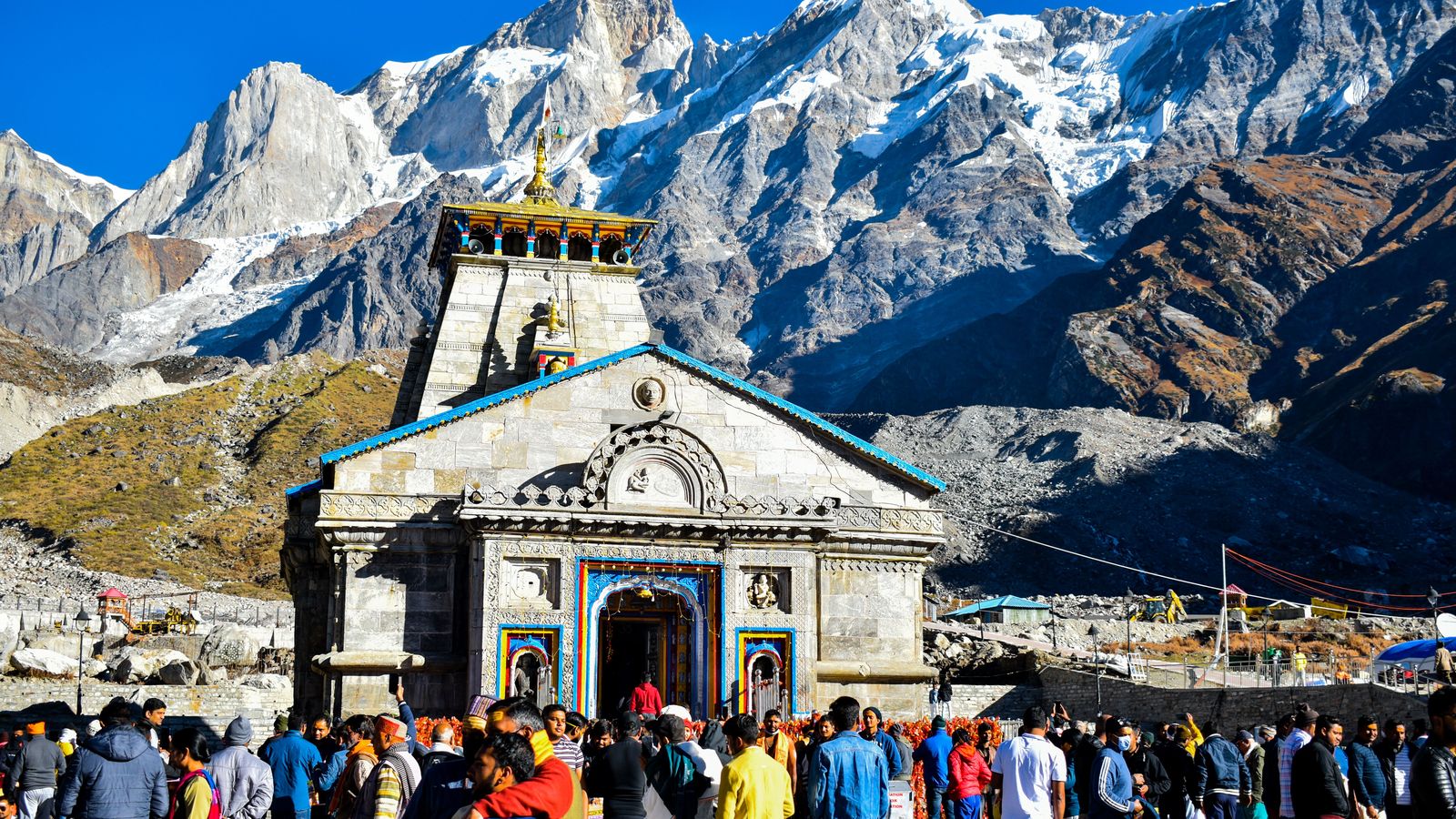
The Char Dham yatra is one of the great journeys of Hindu devotion: the source shrines of the Yamuna and the Ganga at Yamunotri and Gangotri, Lord Shiva at Kedarnath and Lord Vishnu at Badrinath, strung along the high valleys of Garhwal. Pilgrims have walked it for centuries; today most families travel by road, and the car and driver you choose shape the whole experience. RutzIndia.com arranges a Char Dham yatra taxi from Haridwar, Rishikesh, Dehradun or Delhi, in Innovas, Ertigas and tempo travellers driven by hill drivers who work these roads every season.
Char Dham yatra by car: fares
A Char Dham yatra taxi is billed per km with a 250 km daily minimum. A standard 10-day circuit from Haridwar covers about 1,385 km but is billed on 2,500 km: Rs 1,42,500 Pay Now to Reserve in an Innova Crysta, Rs 1,05,000 Pay Now to Reserve in an Ertiga or Rs 1,95,000 Pay Now to Reserve in a tempo traveller, before GST, tolls, permits and the driver's night allowance.
Because the daily kilometres on mountain roads are short, the 250 km per day minimum almost always sets the fare on the yatra. That is normal for hill touring; the car and driver are committed to you for every day, including the days they wait at Janki Chatti and Sonprayag while you walk.
| Package (start and end) | Days | Km billed | Ertiga (Rs 42/km) | Innova Crysta (Rs 57.6/km) | Tempo Traveller (Rs 78/km) |
|---|---|---|---|---|---|
| Do Dham: Kedarnath and Badrinath, from Haridwar | 6 | 1,500 | Rs 63,000 Pay Now to Reserve | Rs 85,500 Pay Now to Reserve | Rs 1,17,000 Pay Now to Reserve |
| Char Dham, from Haridwar | 10 | 2,500 | Rs 1,05,000 Pay Now to Reserve | Rs 1,42,500 Pay Now to Reserve | Rs 1,95,000 Pay Now to Reserve |
| Char Dham, from Delhi | 12 | 3,000 | Rs 1,26,000 Pay Now to Reserve | Rs 1,71,000 Pay Now to Reserve | Rs 2,34,000 Pay Now to Reserve |
Add the driver's night allowance of Rs 1,500 per night (nine nights on the Haridwar circuit), tolls, parking, Uttarakhand entry tax for out-of-state vehicles where collected, and 5% GST. Hotels, ponies, palkis, helicopter tickets and puja fees are separate, and we can suggest reliable options.
Registration: do this first
Every yatri must register before travelling. The Government of Uttarakhand runs the official Char Dham and Hemkund Sahib registration portal, which also has a mobile app. Register each member of your group with photo ID, choose your dates for each dham, and carry the yatra registration letter (printed or on your phone) because it is checked at points along the route. The same portal carries weather advisories; the yatra can be suspended for a day or more when the weather office issues a red alert, and pilgrims are asked to stay at safe locations until roads reopen.
Commercial vehicles on the yatra routes need their own clearances, such as the green card and trip card system for taxis. Our operators arrange these for the car or van before departure, so you only handle the passenger registration.
Temple opening dates, darshan timings and puja bookings for Kedarnath and Badrinath are published by the Badrinath-Kedarnath Temple Committee.
When the shrines open and close
The dhams open each spring on auspicious dates announced every year. Yamunotri and Gangotri traditionally open on Akshaya Tritiya, usually in late April or early May, with Kedarnath and Badrinath opening around the same time or within days. The shrines close for winter around Diwali and Bhai Dooj in October or November, with Badrinath usually the last to close, and the deities move to winter seats at lower altitudes.
- May and June: the busiest weeks, especially the opening fortnight and school holidays. Book cars and hotels early and expect queues.
- July to mid-September: monsoon. Landslides can block roads for hours or days; many families avoid this period, and those who go should allow spare days.
- Mid-September to October: clear skies, fewer crowds and cold nights. Many regular yatris prefer this window.
Day-by-day plan: 10 days from Haridwar
Distances are approximate; hill driving averages 25 to 35 km an hour.
- Day 1, Haridwar to Barkot (about 210 km). Via Dehradun and Mussoorie, then down to the Yamuna valley. Evening rest in Barkot.
- Day 2, Barkot to Janki Chatti and back (about 90 km by road). The car waits at Janki Chatti; you walk about 6 km each way to Yamunotri, or take a pony or palki. Holy dip at the tapt kund, then back to Barkot.
- Day 3, Barkot to Uttarkashi (about 100 km). Kashi Vishwanath temple in Uttarkashi in the evening.
- Day 4, Uttarkashi to Gangotri and back (about 200 km). Along the Bhagirathi through Harsil's apple orchards to Gangotri temple, then return.
- Day 5, Uttarkashi to Guptkashi or Sitapur (about 220 km). A long day via Tehri and Srinagar Garhwal. Early night.
- Day 6, to Sonprayag and the Kedarnath trek (about 10 km by road). Private vehicles stop at Sonprayag; a local shuttle takes you to Gaurikund, and the trek to Kedarnath is about 16 km. Stay overnight near the temple.
- Day 7, Kedarnath darshan and return (about 30 km by road). Morning darshan, trek down to Gaurikund and shuttle to Sonprayag, where your driver is waiting. Night at Guptkashi.
- Day 8, Guptkashi to Badrinath (about 200 km). Via Chopta or Rudraprayag and Joshimath. Evening aarti at Badrinath.
- Day 9, Badrinath to Rudraprayag (about 160 km). Morning darshan and Mana village, India's last village before the Tibet border, then descend.
- Day 10, Rudraprayag to Haridwar (about 165 km). Past Devprayag, where the Bhagirathi and Alaknanda meet to form the Ganga, and Rishikesh.
Starting from Delhi adds the Delhi to Haridwar drive (about 220 km) at each end, making it 12 days. You can also start from Dehradun's Jolly Grant airport; see Delhi to Dehradun taxi and the Rishikesh taxi service for local transfers.
The 10-day circuit as a table
| Day | Route | Approx km by road | Night halt | On foot |
|---|---|---|---|---|
| 1 | Haridwar to Barkot | 210 | Barkot | - |
| 2 | Barkot to Janki Chatti and back | 90 | Barkot | About 6 km each way to Yamunotri |
| 3 | Barkot to Uttarkashi | 100 | Uttarkashi | - |
| 4 | Uttarkashi to Gangotri and back | 200 | Uttarkashi | Short walk to the temple |
| 5 | Uttarkashi to Guptkashi or Sitapur | 220 | Guptkashi / Sitapur | - |
| 6 | To Sonprayag; shuttle to Gaurikund | 10 | Kedarnath | About 16 km trek up |
| 7 | Kedarnath down to Gaurikund; drive to Guptkashi | 30 | Guptkashi | Trek down |
| 8 | Guptkashi to Badrinath | 200 | Badrinath | - |
| 9 | Badrinath and Mana, then to Rudraprayag | 160 | Rudraprayag | Short walk at Mana |
| 10 | Rudraprayag to Haridwar via Devprayag | 165 | - | - |
Road total: about 1,385 km. At hill speeds of 25 to 35 km an hour, the long days (1, 5 and 8) are six to eight hours at the wheel.

Yatra packages by car class
Every package below is billed on its daily minimum of 250 km, which is higher than the kilometres driven on mountain roads.
| Package | Days | Km billed | Sedan (Rs 36) | Ertiga (Rs 42) | Innova (Rs 57.6) | Tempo Traveller (Rs 78) | Fortuner (Rs 84) |
|---|---|---|---|---|---|---|---|
| Ek Dham: Kedarnath from Haridwar | 4 | 1,000 | Rs 36,000 Pay Now to Reserve | Rs 42,000 Pay Now to Reserve | Rs 57,000 Pay Now to Reserve | Rs 78,000 Pay Now to Reserve | Rs 84,000 Pay Now to Reserve |
| Do Dham: Kedarnath and Badrinath | 6 | 1,500 | Rs 54,000 Pay Now to Reserve | Rs 63,000 Pay Now to Reserve | Rs 85,500 Pay Now to Reserve | Rs 1,17,000 Pay Now to Reserve | Rs 1,26,000 Pay Now to Reserve |
| Char Dham from Haridwar | 10 | 2,500 | Rs 90,000 Pay Now to Reserve | Rs 1,05,000 Pay Now to Reserve | Rs 1,42,500 Pay Now to Reserve | Rs 1,95,000 Pay Now to Reserve | Rs 2,10,000 Pay Now to Reserve |
| Char Dham from Delhi | 12 | 3,000 | Rs 1,08,000 Pay Now to Reserve | Rs 1,26,000 Pay Now to Reserve | Rs 1,71,000 Pay Now to Reserve | Rs 2,34,000 Pay Now to Reserve | Rs 2,52,000 Pay Now to Reserve |
Night allowances (3, 5, 9 or 11 nights at Rs 1,500 Pay Now to Reserve), tolls, parking, Uttarakhand entry tax for out-of-state vehicles where collected, and 5% GST are added. A sedan can manage the route with two or three passengers and light luggage, but for anyone over 60 or any family with suitcases we recommend an Innova Crysta or, on a budget, an Ertiga. Groups should look at a tempo traveller, and the Fortuner suits those who want an SUV's clearance and presence.
Ek Dham: Kedarnath only, in four days
For families short of time, a Kedarnath-only yatra from Haridwar or Rishikesh is common.
- Day 1: Haridwar to Guptkashi or Sitapur, about 200 km, via Rishikesh, Devprayag and Rudraprayag.
- Day 2: drive to Sonprayag, shuttle to Gaurikund and trek about 16 km to Kedarnath; night near the temple.
- Day 3: morning darshan, trek down, drive back to Guptkashi.
- Day 4: Guptkashi to Haridwar, about 200 km.
About 440 km on the road, billed on the four-day minimum of 1,000 km: Rs 57,000 Pay Now to Reserve in an Innova.
Distances to each dham by road
| Shrine | Nearest road head | Approx km from Haridwar to road head | Final approach |
|---|---|---|---|
| Yamunotri | Janki Chatti | about 255 | Trek of about 6 km |
| Gangotri | Gangotri town | about 300 | Short walk from parking |
| Kedarnath | Sonprayag, then Gaurikund by shuttle | about 235 | Trek of about 16 km |
| Badrinath | Badrinath town | about 315 | Short walk from parking |
Distances are approximate and depend on the route taken; landslide diversions can add kilometres in the monsoon.
Helicopters to Kedarnath
Helicopter services fly to Kedarnath from helipads in the Phata, Sersi and Guptkashi area during the season. Tickets are sold only through the official booking channel announced by the Uttarakhand government each year (in recent seasons, an IRCTC heli-yatra portal); avoid agents selling tickets on social media. If you fly, your car drops you at the helipad on the morning of your slot and collects you after the return flight, which usually lets you do Kedarnath in a single day and shortens the itinerary.
Starting from Dehradun or Rishikesh
Many yatris fly into Jolly Grant airport near Dehradun, about half an hour from Rishikesh. We meet the flight with a name board (30 minutes of free waiting for a domestic arrival) and start the circuit from there, which saves the drive from Delhi. Rishikesh also makes a good first night: the Ganga aarti at Triveni Ghat is a fitting start to the yatra. See the Dehradun taxi service for local transfers.
Choosing the right vehicle for the hills
Innova Crysta is the preferred car for families of up to six: ground clearance, a strong engine for long climbs, and seats that stay comfortable over ten days. Ertiga suits four travellers on a tighter budget, with lighter luggage. Tempo traveller works for groups of 9 to 16 and is widely used on the yatra; ask for a 12 or 17 seater rather than the longest bodies, which struggle on some hairpins. See tempo traveller in Haridwar and tempo traveller in Dehradun for local van options. Large buses and coaches are not suitable for most of the route.
All vehicles are commercially registered, within four model years, and permitted for the yatra. Drivers are Garhwal-experienced; they know where landslides usually fall, which dhabas are open early, and how to pace a vehicle on long descents.
Char Dham by tempo traveller: cost per pilgrim
Groups from the same colony, temple committee or extended family often travel together. For a 12 pilgrim group in a 12 seat tempo traveller on the 10-day circuit from Haridwar, the van fare is Rs 1,95,000 Pay Now to Reserve on the 2,500 km minimum, or about Rs 16,260 per person before night allowances, tolls, entry tax, parking and GST. From Delhi over 12 days it is Rs 2,34,000 Pay Now to Reserve, about Rs 19,500 each. A 17 seater lowers the per-head cost further if the group is larger, but the longest vans struggle on some hairpins, so for mountain routes we recommend vans no larger than 17 seats.
Month-by-month weather on the yatra
- Late April and May: days pleasant at lower altitudes, cold at the dhams, with snow still lining the upper roads early in the season. Crowds peak.
- June: warm in the valleys, pre-monsoon showers begin later in the month; school holidays keep numbers high.
- July and August: monsoon rain, landslides and road closures; the yatra continues but with frequent interruptions and suspensions on red-alert days.
- September: rain eases through the month; roads may still be recovering from monsoon damage.
- October: clear skies and crisp air, cold nights, the best mountain views, and fewer pilgrims until the closing ceremonies around Diwali and Bhai Dooj.
Food, stay and facilities on the route
Towns along the circuit, including Barkot, Uttarkashi, Guptkashi, Sitapur, Joshimath and Rudraprayag, have hotels, guest houses and dharamshalas across budgets, and simple vegetarian food is available everywhere; the yatra route is largely vegetarian and alcohol-free near the shrines. At Kedarnath, stays near the temple are basic and book up early in peak season. ATMs and mobile coverage thin out in the upper valleys, so carry some cash. Your driver arranges his own lodging from the night allowance and will often know which hotels have parking, which matters in narrow hill towns.
Documents checklist for every yatri
- Yatra registration letter for each traveller, printed or on the phone
- Original photo ID (Aadhaar, passport or voter ID) matching the registration
- Medical prescriptions and a small kit, especially for elders
- Hotel confirmations and our booking details with the driver's name
- Some cash for the upper valleys, where ATMs are few
The driver carries the vehicle's registration, permit, insurance and any yatra-route clearances for the car.
Pujas and special darshan
Special pujas at Kedarnath and Badrinath, and the timings of the morning and evening aarti, are managed by the temple committee, which publishes details and booking information on its official site. Book any paid pujas in advance where possible, and plan your arrival day so you are not rushing from the car park to a fixed puja time after a long drive or trek.
Why the daily minimum applies on the yatra
First-time yatris are sometimes surprised that a circuit of about 1,385 km is billed on 2,500 km. The reason is simple: the car and driver are yours for ten full days, including days spent mostly waiting while you trek to Yamunotri and Kedarnath, and days when mountain roads limit how far anyone can drive. The 250 km per day minimum is how hill touring is priced across the industry, and ours is lower than the 300 km floor many operators use. If you would prefer to pay less, shorten the itinerary rather than the daily rate: a Do Dham trip, or a helicopter for Kedarnath, cuts both days and cost. We are happy to show you two or three versions of the itinerary side by side before you decide, each with its full fare worked out, so the choice between comfort, time and budget is made with clear numbers.
Health, safety and packing
The dhams sit at high altitude: Kedarnath at roughly 3,500 metres and Badrinath above 3,100 metres. The state encourages elderly pilgrims and those with heart or lung conditions to get a medical check before travelling, and health screening points operate on the route.
- Walk slowly on the Kedarnath and Yamunotri treks, and drink water regularly.
- Carry warm layers even in June; nights at Kedarnath are cold, and rain can come any afternoon.
- Keep ID, the yatra registration and some cash handy; network coverage is patchy in the upper valleys.
- Book pony, palki or helicopter services only through official counters and authorised channels.
- Follow your driver's advice on start times. We plan hill legs to finish before dark where possible, so the night halt is reached in daylight.
For other pilgrim circuits, including Vaishno Devi, Vrindavan and Shirdi, see our pilgrimage taxi guide.
Worth adding: side trips on the circuit
- Tungnath and Chopta. Between Guptkashi and Badrinath, the meadows of Chopta lead to Tungnath, among the highest Shiva temples in the world and one of the Panch Kedar. Add a day.
- Hemkund Sahib and the Valley of Flowers. From Govindghat near Joshimath, a trek leads to the Sikh shrine of Hemkund Sahib and the Valley of Flowers, which blooms from July to September. Hemkund registration uses the same state portal.
- Devprayag and Rishikesh. Break the last day at Devprayag's confluence and finish with the evening Ganga aarti at Rishikesh's Triveni Ghat; see the Delhi to Rishikesh taxi for the drive home.
- Harsil and Mukhba. Near Gangotri, a quiet valley of apple orchards and the winter seat of the Gangotri deity.
Each extra day is billed at the same terms: the 250 km minimum for the day, plus one night allowance.
Travelling with elderly parents
Many families bring parents on the yatra as a once-in-a-lifetime pilgrimage. A few adjustments make it far easier. Choose an Innova and seat them in the middle row. Add a rest day after Kedarnath. Book palkis or helicopter tickets early through authorised channels if walking 16 km uphill is not realistic. Keep medicines, a pulse oximeter and a warm shawl in the car, not in the roof luggage. Ask the driver to stop more often on the long days to Barkot and Guptkashi. If they start from Dehradun, the Dehradun taxi service can collect them at Jolly Grant airport.
Booking and cancellation
Share your dates, starting city, group size and the dhams you plan to visit via the online booker or WhatsApp. We send a day-by-day route with kilometres and a written fare, confirm the vehicle and driver, and take an advance by card or UPI; the balance is paid at the end of the yatra. If weather suspends the yatra, we work with you on revised dates; extra days are billed at the same daily terms.
Our cancellation policy applies: free more than 72 hours before departure, 10% within 72 hours, 50% within 48 hours, and 100% within 24 hours or on a no-show. Given the demand in May and June, we suggest booking the car as soon as your registration dates are fixed. The state's Uttarakhand Tourism site is a good companion for planning stays and side trips.