How do you reach Ellora and Ajanta by road?
Drive to Aurangabad, now officially Chhatrapati Sambhajinagar, about 235 km from Pune, typically 5 hours via Ahilyanagar. Ellora is 30 km beyond the city and Ajanta about 100 km. A RutzIndia.com sedan costs Rs 8,460 Pay Now to Reserve one way from Pune, an Innova Rs 13,390 Pay Now to Reserve, before 5% GST, with tolls and parking at cost.
Few places in the world pack as much genius into as short a drive as the country around Aurangabad. Thirty kilometres to the north-west lie the caves of Ellora, where over several centuries Buddhist, Hindu and Jain communities cut monasteries and temples side by side into a basalt escarpment, culminating in the Kailasa temple, carved from the top of the hill downwards as a single monolith. A hundred kilometres to the north, in a horseshoe bend of the Waghur river, the monks of Ajanta painted their cave halls with murals of the Buddha's lives that remain among the greatest surviving works of ancient Indian art. Both are UNESCO World Heritage Sites, and both are best reached by car.
A driver is not merely a convenience here. The two sites are in opposite directions from the city, their closing days differ, and at Ajanta private vehicles must stop at a visitor centre some distance from the caves. Getting the sequence right is the difference between a satisfying trip and a frustrating one. This guide gives you the routes, the rules, the seasons, a three-day plan and our fares.
What you will see
Ellora (about 30 km from the city)
Ellora's 34 principal caves stretch for about 2 km along the hillside, numbered roughly in chronological order.
- Buddhist caves (1 to 12). Monasteries and a chaitya hall, the "Carpenter's Cave" (Cave 10), with a ribbed ceiling imitating timber, and the three-storeyed Caves 11 and 12.
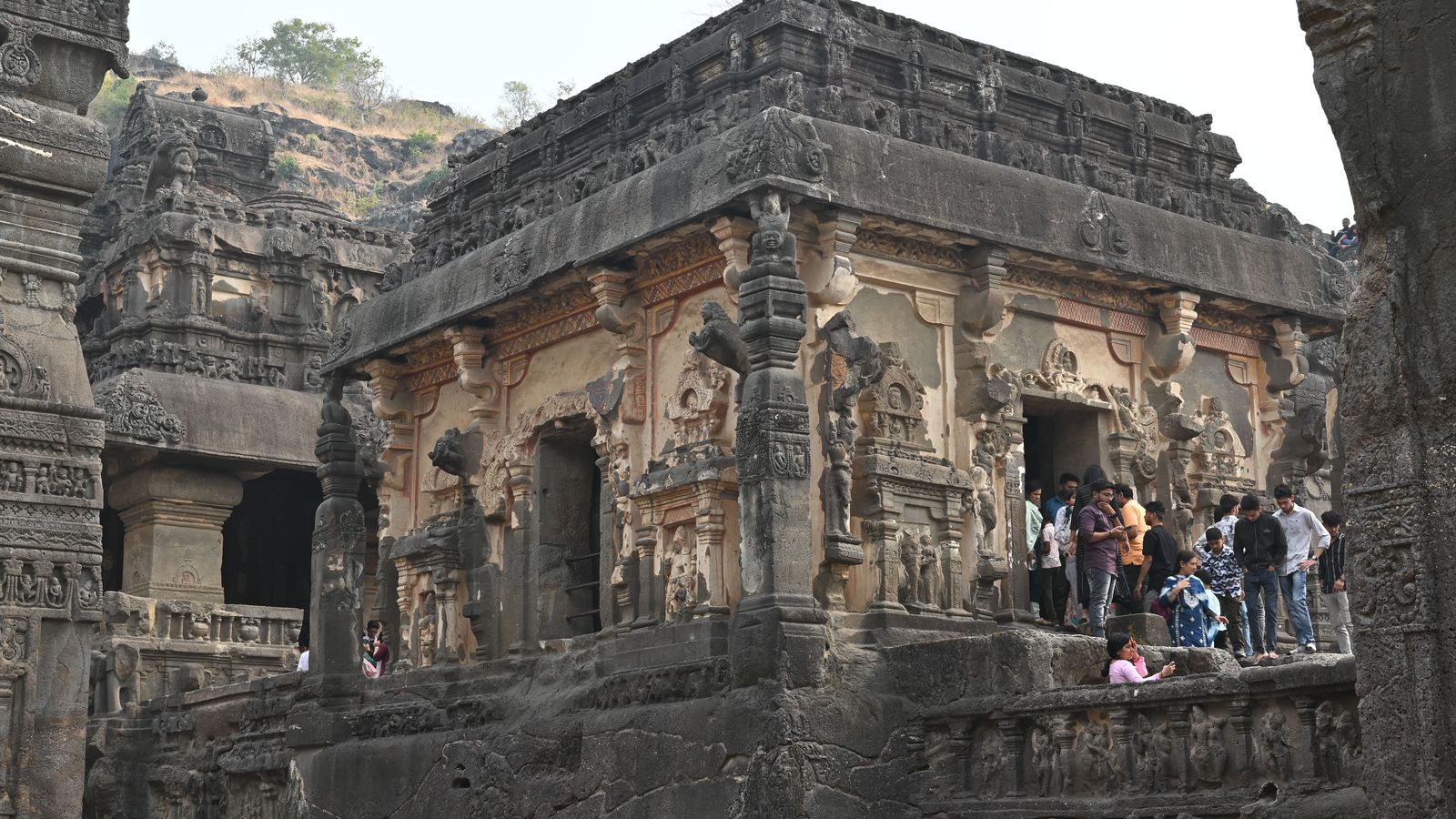
- Hindu caves (13 to 29). The heart of Ellora. Cave 16, the Kailasa temple, is the showpiece: an entire multi-storey temple complex with a shrine, gateway, pillars, elephants and friezes, all excavated from a single mass of rock around the eighth century under the Rashtrakuta dynasty. Walk the upper galleries for the scale of it.
- Jain caves (30 to 34). Quieter and finely detailed, particularly the Indra Sabha.
Ellora is closed on Tuesdays. Just outside, the Grishneshwar temple, one of the twelve Jyotirlingas, is a short drive away, and the small town of Khuldabad sits on the ridge above.
Ajanta (about 100 km from the city)
Around 30 caves cut into a cliff above a river gorge, begun around the second century BCE and expanded in a great burst of activity in the fifth century CE. The paintings in Caves 1, 2, 16 and 17 are the most celebrated, including the graceful Bodhisattva Padmapani in Cave 1. Lighting inside is deliberately low to protect the murals, so give your eyes time to adjust.
Ajanta is closed on Mondays. Private cars, including yours, stop at the visitor centre at the T-junction near Fardapur; from there, authorised buses shuttle visitors about 4 km to the base of the caves. Your chauffeur waits at the parking area. Climb to the viewpoint across the gorge for the view the British officer who rediscovered the caves in 1819 would have had.
In and around the city
- Bibi Ka Maqbara, a seventeenth-century mausoleum built for Aurangzeb's wife, often called the Taj of the Deccan for its resemblance to the Taj Mahal.
- Daulatabad Fort, the formidable hill citadel of Devagiri, with its Chand Minar, moat and dark spiral tunnel. It lies on the Ellora road and fits easily into that day.
- Aurangabad Caves, a lesser-known group of Buddhist caves on the hills above the city.
- Panchakki, a water mill fed by an underground channel.
- Paithani and Himroo. The silk-and-zari Paithani sarees of Paithan, about 55 km south, and the city's Himroo weaves make fine souvenirs.
The Archaeological Survey of India manages these monuments and sets tickets, timings and photography rules. For deeper background, the Ajanta Caves and Ellora Caves articles are thorough starting points.
The drive
From Pune (about 235 km). The usual route leaves Pune through Wagholi and Shikrapur, runs to Ahilyanagar (formerly Ahmednagar), then north-east through Newasa to the city. It is a busy highway rather than an expressway, with towns and truck traffic along the way, so allow five hours with a breakfast stop. Ahilyanagar has good restaurants for a mid-way break.
From Mumbai (about 335 km). Either the Nashik road via the Kasara Ghat and on through Vaijapur, or the Samruddhi Mahamarg, which has an interchange for the city and often saves time. Six to seven hours is typical. A one-way sedan from Mumbai is about Rs 12,060 Pay Now to Reserve.
From Shirdi (about 110 km). Many pilgrims combine the Sai shrine with Ellora; see our Shirdi by road guide.
Between the sites. The city to Ellora is a short, easy run past Daulatabad. The city to Ajanta runs north on the Jalgaon road through Sillod, about 2.5 hours each way. Ellora to Ajanta directly is also about 100 km.
By air. The city's airport at Chikalthana has domestic connections. We meet arrivals with a name board and flight tracking, with 30 minutes' free waiting after domestic flights and 60 after international.
When to go
October to March is ideal: dry, pleasant, with clear light for photography. It is also when the caves are busiest, especially over Diwali and Christmas.
The monsoon (July to September) is magical at Ajanta, when the waterfall at the head of the gorge runs and the hills turn green, and many people consider it the most beautiful time to visit. Rain is usually moderate here compared with the coast.
April to June is very hot, often above 40°C. If you must go then, start at dawn and plan indoor time at midday.
Remember the closing days, Tuesday for Ellora and Monday for Ajanta, and plan around public holidays when both are crowded.
Chauffeured services and fares
RutzIndia.com offers the cave country as a one-way transfer, a two- or three-day circuit from Pune or Mumbai with the car staying with you, local sightseeing from the airport or railway station, and longer journeys combining Shirdi, Nashik and the caves. All cars are within four model years.
| From Pune | Dzire sedan | Honda City class | Innova Crysta | Tempo Traveller |
|---|---|---|---|---|
| One way to the city (about 235 km) | Rs 8,460 Pay Now to Reserve | Rs 11,280 Pay Now to Reserve | Rs 13,390 Pay Now to Reserve | Rs 18,330 Pay Now to Reserve |
| Three-day circuit incl. Ellora and Ajanta (about 770 km) | Rs 27,720 Pay Now to Reserve | Rs 36,960 Pay Now to Reserve | Rs 43,890 Pay Now to Reserve | Rs 60,060 Pay Now to Reserve |
| Per km on the circuit | Rs 36 | Rs 48 | Rs 57.6 | Rs 78 |
Fares exclude 5% GST. Tolls, parking at Ellora and at the Ajanta visitor centre, and the driver night allowance of Rs 1,500 per night are billed at actual cost. Monument tickets and the Ajanta shuttle bus are paid by you on site. Multi-day hires are charged on the greater of actual kilometres or 250 km per calendar day; the circuit above comfortably exceeds the minimum.
Heritage groups, school tours and family reunions often travel in a Tempo Traveller or an Urbania; see tempo traveller in Pune and Urbania on rent.
Cancellation is free more than 72 hours before pickup, then 10% within 72 hours, 50% within 48 hours and 100% within 24 hours or on a no-show, as described on the cancellation policy page. You can book online and pay by card or UPI.
Three days in cave country: a suggested plan
Day 1: Pune to the city (about 250 km). Leave by 7 am, breakfast near Ahilyanagar, arrive by early afternoon. Bibi Ka Maqbara in the late-afternoon light and Panchakki before dinner.
Day 2: Daulatabad, Ellora and Grishneshwar (about 70 km). Daulatabad fort at opening time, before the heat. Ellora from late morning, starting with the Buddhist caves and working up to Kailasa, then the Jain caves. Grishneshwar darshan on the way back. Not a Tuesday.
Day 3: Ajanta, then home or onward (about 450 km). An early start for Ajanta, arriving for opening time, three hours at the caves, lunch at Fardapur, then either back to the city for the night or a long drive home to Pune. Not a Monday. Many travellers prefer to add a fourth night and return fresh.
Who we drive to the caves
The cave country draws an unusually varied set of travellers, and we shape each trip around them.
Foreign visitors and NRIs often arrive on a longer India itinerary and want a car, a patient driver and some flexibility to linger at Kailasa or return to Ajanta's painted halls for a second look. Our NRI car hire in India page explains how we handle international bookings, foreign cards and airport meet-and-greet.
Pilgrims combine Grishneshwar with Shirdi, Shani Shingnapur, Trimbakeshwar and sometimes Bhimashankar, completing several Jyotirlingas on one journey. Our pilgrimage taxi service builds these circuits with realistic daily distances.
Students, historians and photographers tend to want early starts and long days on site. The driver simply waits; the only rule is that we plan the return so nobody drives the highway tired late at night.
Families usually prefer three or four nights with a comfortable hotel in the city, a pool for the children and a mix of caves, fort and bazaar. A one-way return by air from the city's airport, with a one-way taxi on the outward leg only, is an efficient option.
Practical tips
- Plan by weekday. Ellora on Tuesday or Ajanta on Monday means a closed gate.
- Footwear and water. The caves involve steps and walking in the sun; carry water and a hat.
- Photography. Flash is prohibited inside the painted caves at Ajanta. Tripods and drones need permission.
- Guides. Licensed ASI guides are available at both sites and are well worth it for the stories behind the carvings.
- Food. Try the city's naan qalia, a rich mutton stew with bread, and the local sweets; there are simple restaurants near both sites.
For other long drives across the state, see our outstation cabs, and for city transfers at the Pune end, car rental with driver in Pune.