Shravanabelagola by car: the quick answer
Shravanabelagola is about 145 km from Bangalore, typically 3 hours on the Bangalore-Hassan highway (NH75) with a short turn-off at Channarayapatna or Hirisave. A RutzIndia.com sedan is Rs 5,220 Pay Now to Reserve one way and an Innova Crysta Rs 8,270 Pay Now to Reserve; a same-day return of about 290 km costs Rs 10,440 Pay Now to Reserve in a sedan. Prices are before 5% GST, with tolls and parking at cost.
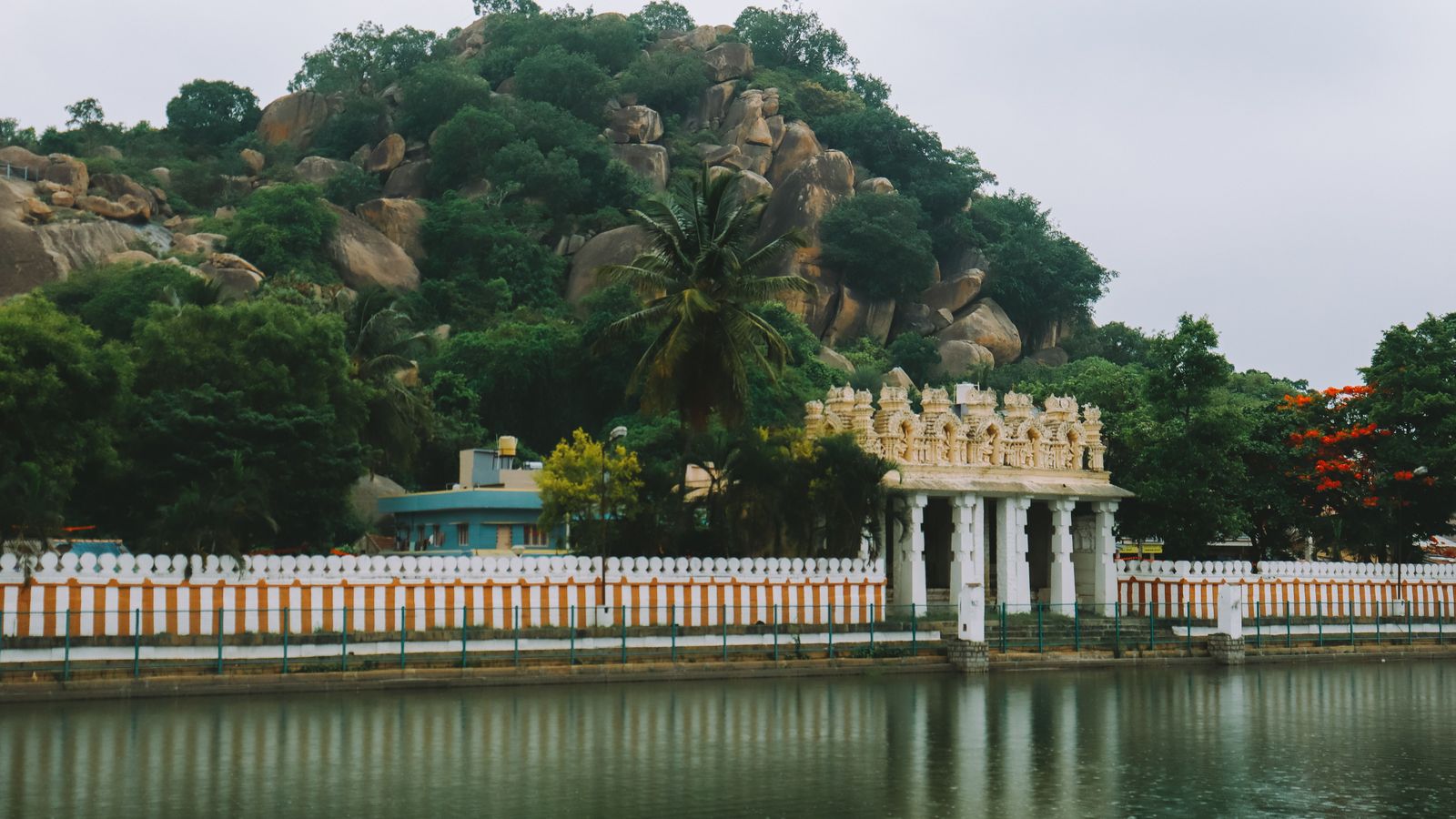
Few places in South India feel as timeless as Shravanabelagola. The name is usually explained as the "white pond of the Shravanas", after the tank that lies between two granite hills, Vindhyagiri and Chandragiri, at the heart of the town. On the summit of Vindhyagiri stands the statue of Gommateshwara, or Bahubali, carved from a single block of granite in the late tenth century on the orders of Chavundaraya, a minister of the Western Ganga dynasty. At roughly 17 metres, it is one of the largest free-standing monolithic statues in the world, and its serene, unclothed figure, with creepers carved winding around its legs, is a defining image of Jain spirituality.
For Jain families it is among the most important pilgrimage places in India. For everyone else, it is an extraordinary sight, an easy drive and a peaceful counterpoint to the bustle of Bangalore. This guide covers the road, the climb, the calendar and our fares, whether you are coming for darshan, for history, or as part of a Hoysala temple circuit.
What to see and do in Shravanabelagola
Vindhyagiri and the Gommateshwara statue. Several hundred rock-cut steps lead up the smooth granite dome to the shrine enclosure. The climb is steep but short, usually 20 to 40 minutes at a steady pace, and must be done barefoot. At the top, the statue towers over a pillared courtyard with smaller shrines. Mornings are best, before the rock absorbs the sun.
Chandragiri. The smaller hill opposite is covered in basadis (Jain temples) and inscriptions, some among the oldest in Kannada. Tradition links it to the emperor Chandragupta Maurya, who is said to have come here with his teacher Bhadrabahu and ended his life by the Jain rite of sallekhana. The Chavundaraya basadi is the finest structure.
Bhandari basadi and the Jain Math. In the town below, the Bhandari basadi houses images of the twenty-four tirthankaras, and the Jain Math has murals depicting Jain stories.
The Kalyani tank. The large stepped pond between the two hills gives the town its name. Its ghats are a lovely place to rest after the climb.
Nearby. Jinanathapura, a village a short distance away, has a beautifully carved Hoysala-era basadi. The Hoysala masterpieces at Belur and Halebidu are about 85 to 100 km further along the highway, and the Vaishnava hill temple of Melukote lies to the south.
For more depth, the Shravanabelagola article on Wikipedia summarises the history and inscriptions, and the Hassan district website publishes tourist information and local notices.
The story behind the statue
Understanding who Bahubali was makes the climb far more meaningful. In Jain tradition he was a son of Rishabhanatha, the first tirthankara. When their father renounced the world, Bahubali and his elder brother Bharata fought for the kingdom in a series of duels meant to avoid bloodshed among their armies. Bahubali won, but in the moment of victory he saw the futility of pride and possession, gave the kingdom to his brother and withdrew to meditate.
He is said to have stood motionless in meditation for so long that vines grew around his limbs and anthills rose at his feet, details the sculptors carved faithfully into the granite. He attained omniscience, and for Digambara Jains he represents the triumph of renunciation over ambition. That is why the figure is nude, calm and utterly still, and why pilgrims climb to it barefoot.
Chavundaraya, who commissioned the statue, also wrote an important early Kannada prose work, and inscriptions on both hills record donations, vows and the deaths of monks and nuns over many centuries. A good local guide or the booklets sold in town will help you read the site as a living record rather than simply a monument.
A note for first-time and overseas visitors
Shravanabelagola is an active place of worship, not a museum, and a little preparation goes a long way. Plan for simple vegetarian food and no alcohol in town. Mornings are for pilgrims; if you are visiting mainly for photography, respect those praying and keep voices low in the shrine enclosure. Guesthouses run by the Jain institutions offer modest rooms if you want to stay the night and watch the sunrise from Chandragiri. Your chauffeur can drop you near the steps, hold your bags and shoes in the car, and meet you on the other side of the tank when you are done.
Driving to Shravanabelagola
From Bangalore
Your chauffeur heads out of the city on Tumakuru Road and turns west onto NH75 at Nelamangala. The highway passes Kunigal and the wide agricultural plains of Tumakuru and Hassan districts before reaching the Channarayapatna area. From here, a short road of roughly a dozen kilometres leads south to Shravanabelagola. The highway is four-laned with tolls, collected at actual cost on your invoice. The NHAI website has general information on national highway tolling.
The real time-sink is leaving Bangalore. Weekday mornings on Tumakuru Road can be slow around Peenya; Saturday and Sunday mornings are much easier. Kunigal has several good breakfast stops for idli-vada and filter coffee.
From Mysore
The drive from Mysore, about 85 km, runs north through Mandya district's sugarcane country via K.R. Pet. It pairs naturally with a stay in the palace city; see Mysore by road.
From Hassan and the Hoysala towns
If you are coming from Belur, Halebidu or the coffee hills of Chikmagalur by road, Shravanabelagola sits conveniently on your way back to Bangalore.
When to go, and the Mahamastakabhisheka
The climate is dry and warm for most of the year. October to February is the most comfortable period, with cool mornings that make the barefoot climb pleasant. March to May is hot, and the granite can burn bare feet by late morning; go at opening time. June to September brings intermittent rain, which makes the rock slippery; take care on the steps.
The great event is the Mahamastakabhisheka, the head-anointing ceremony held roughly once every twelve years, when the statue is bathed from scaffolding with water, milk, sugarcane juice, saffron paste and flowers before hundreds of thousands of devotees. The most recent took place in 2018, and the next is expected around 2030. During the festival, traffic arrangements, parking and access change completely, so plan with the local administration's advisories in hand.
Jain festivals such as Mahavir Jayanti and the Paryushan period also bring pilgrims, and weekends in the winter are busier than weekdays.
Chauffeured options from RutzIndia.com
Shravanabelagola is one of our most popular day trips from Bangalore, and also a favourite stop on longer Karnataka circuits. Every car is within four model years, and chauffeurs are used to pilgrim schedules: early starts, waits while you climb, and unhurried returns. Book online with card or UPI; companies and trusts can request GST invoices.
| Route | Sedan | Innova Crysta | Tempo Traveller |
|---|---|---|---|
| Bangalore to Shravanabelagola, 145 km one way | Rs 5,220 Pay Now to Reserve | Rs 8,270 Pay Now to Reserve | Rs 11,310 Pay Now to Reserve |
| Same-day return from Bangalore, about 290 km | Rs 10,440 Pay Now to Reserve | Rs 16,530 Pay Now to Reserve | Rs 22,620 Pay Now to Reserve |
| Mysore to Shravanabelagola, about 85 km one way (minimum fare applies) | Rs 3,630 Pay Now to Reserve | Rs 6,390 Pay Now to Reserve | Rs 9,870 Pay Now to Reserve |
| Two-day Hoysala loop incl. Belur, Halebidu (500 km billed) | Rs 18,000 Pay Now to Reserve | Rs 28,500 Pay Now to Reserve | Rs 39,000 Pay Now to Reserve |
Every figure excludes 5% GST. Toll charges, parking fees at the foot of the hill and any permit are added exactly as paid. Overnight journeys bill at least 250 km per calendar day, and the chauffeur is paid a night allowance of Rs 1,500 for each night away from base.
On cancellations: there is no charge if you cancel more than 72 hours before the pickup time. After that a sliding scale applies, with 10% payable inside 72 hours, 50% inside 48 hours, and the entire fare inside 24 hours or for a no-show; see our cancellation policy.
For temple groups, a Tempo Traveller from Bangalore seats up to 16 depending on the configuration. Our pilgrimage taxi service can also build a longer Jain or multi-faith itinerary, adding Karkala, Moodbidri and Dharmasthala on the coast.
Book a Shravanabelagola day trip
Itineraries by car
Classic day trip (about 290 km). Leave Bangalore at 6.30 am, breakfast in Kunigal, and start the Vindhyagiri climb by 9.30 am. Descend by 11, rest at the Kalyani tank, visit the Bhandari basadi and the Jain Math, and have a simple vegetarian lunch in town. In the afternoon, climb Chandragiri for its basadis and inscriptions, then drive back to reach Bangalore by early evening.
Two days with the Hoysala temples (about 470 km). Day 1: Bangalore to Shravanabelagola, climb Vindhyagiri, then continue to Hassan or Belur for the night. Day 2: Belur's Chennakeshava temple in the morning, Halebidu's Hoysaleswara temple before lunch, and the drive home on NH75.
Mysore circuit (about 400 km over two days). Bangalore to Mysore on day 1, then Mysore to Shravanabelagola and back to Bangalore on day 2 via Channarayapatna.
Tips for the climb and the visit
- Barefoot rule. Footwear is left at the base; there are stalls to keep shoes. Carry cotton socks to wear on hot granite.
- Timing. Start the climb early; the rock heats quickly after 10 am.
- Elders. Palanquin (doli) bearers have traditionally carried pilgrims who cannot climb; availability and rates vary, so ask on arrival.
- Dress. Modest clothing is expected at all Jain shrines; leather items should be left in the car.
- Food. Vegetarian meals are available in town, many following Jain dietary rules, and most kitchens close early in the evening; carry water and a light snack for the climb.
- Photography. Photography of the statue is generally allowed, but follow any signs at individual shrines.
- Parking. Cars park near the foot of Vindhyagiri; your chauffeur waits there and can meet you at the Chandragiri side later.
Travelling onward to the coast? Mangalore's temples and Udupi by road can be reached via the Shiradi ghat, with Sakleshpur on the way.